
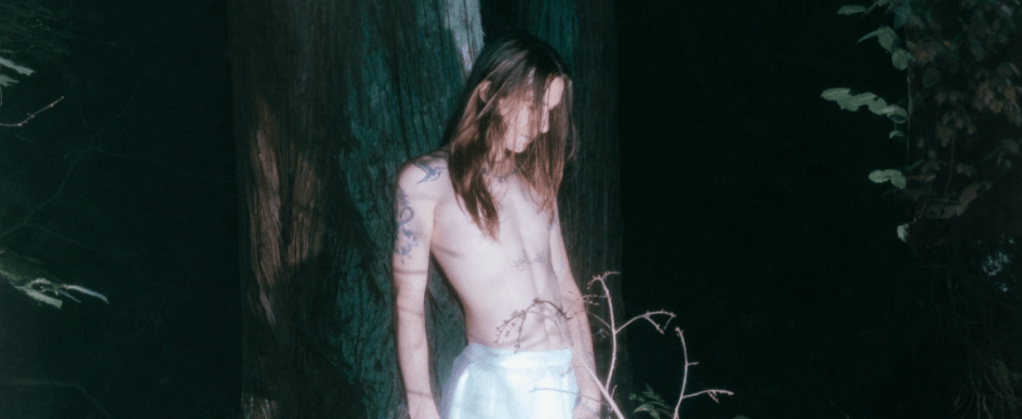
featured image shot by Delilah Lovejoy and Eli Lu
“It took me some time to really find my voice as an artist, literally because of the surgery, but also figuratively.”
Losing one’s voice is more than just a physical loss – it’s also emotional, social, and psychological loss. Aidan Ashland battled through their loss with songwriting and patience, carefully crafting their return to music. The product, “The Harm & The Benefit,” is finally here, reflecting their battle and the ways that it has changed them.
DEATH OF A RABBIT: You have a handful of one-off singles, continuous throughout the years. Is there a project forming at all?
AIDAN ASHLAND: It took me some time to really find my voice as an artist, literally because of the surgery, but also figuratively. In the years I was spending finding and honing (my voice), I was writing a lot of songs and working with a lot of other people in different capacities, like playing in people’s bands, helping people arrange their music, working as a producer, as a songwriter… Collaboration is just so fun. It’s fun to bounce ideas off other people and help something take shape. For a long time, I was focused on the collaboration piece of it, and I wasn’t ready yet to put anything out under my name because I wasn’t totally aligned with my voice yet. But that’s changed. In the last two years, I started working with my producer, Andreas, and honed in on a batch of songs that were like, “Okay, that’s what I sound like. That’s what I want to sound like.” I feel like the universal thing for artists is to have some shyness or embarrassment about sharing their art, because it’s a very vulnerable thing. I definitely experienced that. But I think a key indicator for me (that I’d found my voice) was that with the batch of songs I’m working on now, I don’t have any of that embarrassment or shyness. I’m just really aligned with it. I’m like, “No, that’s who I am. That’s what I sound like.”
DOAR: What was it like finding your voice, literally and figuratively? Was it frustrating at all, not knowing what your “thing” was or exciting being able to explore that?
AIDAN ASHLAND: I think mostly in my life, I’ve been pretty down to move at my own pace. My parents were really supportive and kind. My dad especially nurtured a very curious and thoughtful worldview and outlook for me. That’s always been the way that I’ve approached life. I want to understand things; I’m not going to stop asking questions until I understand it. When I’m meeting someone and they ask, “What do you do?” and I answer, “I’m a musician,” it feels good to finally be able to answer that in a quick, easy way. But, I haven’t felt a ton of anxiety about that piece of it, because I just wasn’t ready yet and (wasn’t going to answer that question, that way) until I was super sure, and now I’m super sure.
DOAR: That’s so exciting. What was one of the most helpful things that you learned from collaboration with all of these amazing artists?
AIDAN ASHLAND: My first and most impactful collaborator was my younger sibling, Iona, who passed away two years ago unexpectedly. We were really close. It was a traumatizing thing that happened and it really reshaped me and my world. We had such a personal but also artistic relationship for their entire life. That (relationship) shaped the way I approach melody and harmony and the way I write lyrics; even though they’re not physically around anymore, they’re still very much up here [points to their head.] That (relationship) was super helpful for me as a lyricist, especially to not be super self-conscious about lyric writing. So much of lyric writing in the early stages is just nonsense, you know, it’s just like, “Let me make sounds and say silly words until I find what it is that I’m really trying to say,” and Iona was always good at that. They didn’t have a lot of self-consciousness about it. So (what they taught me) is something I really benefited from and reflect on often.
DOAR: I got the pleasure to listen to your newest song, “The Harm & the Benefit.” How was the production of it? Because there’s a lot of layers to it, I was wondering how you were able to build on it.
AIDAN ASHLAND: Do you cook much?
DOAR: Yes, I know how to cook.
AIDAN ASHLAND: Ok, so it’s sort of like that: you’re tasting as you’re going and adding what you think should be there, and maybe you add a little bit too much of one thing and need to add something else to balance it. I get fixated on my work. Even when I’m not actively working on it, it’s always going in my head all day, no matter what, until it’s well and truly done. Usually what that means for me and what that meant for this song, was a lot of the melodies or melodic themes you hear were a pretty integral layer, but ill defined. I was like, “I know that I want this melody in there. Where and how and what does it sound like? That (melody) I’m less certain about other than I want it to be there and I want it to feel like this.” That’s where my collaboration with Andreas really brought this song to life, because they are so good at taking abstract, vague sentiments and turning them into a real, tangible thing. In my apartment in New Orleans, I had this – do you know what a Wurlizer is?
DOAR: No, I don’t!
AIDAN ASHLAND: It’s one of the early electric pianos. Back in the day, before it was a computer or anything, it was basically like an amplified piano. What that meant was that the inside still had, in this case, a big brass skeleton with string attached to it. I had the guts of a Wurlitzer in my apartment. That was one of the things Andreas recorded, and wanted me to record, but in the song it’s just scratching the strings of the inside of this piano. Taking all those elements and piecing them together was really fun. Another thing that was pretty crucial in the overall impact was Andreas and I’s objectivity about what should or should not stay. There were many different iterations of this song, and I think it would have been easy to just have a full smorgasbord of every cool idea we had, but subtraction and editing down was crucial to give off the sentiment the song ended up having.
DOAR: You also mentioned the chorus came pretty easily to you, but the verses were more challenging. What did you learn about yourself as a songwriter through the process of pushing yourself to create the verses?
AIDAN ASHLAND: That’s another instance of feeling comfortable going at my own pace. Adrianne Lenker talks about this idea of creativity as a river that’s ever-flowing that she puts her hand in or out of which I really think is a beautiful metaphor. That’s also sort of how I feel. I know the creative energy or force is always there and I am just here to access it. (With the) chorus, it’s such a treat when a song just plops out of your head. That’s happened to me a few times, but mostly it takes time to take shape. I’ve been writing songs for over a decade at this point, and one of the big things I’ve learned is to not push it, not rush it, just keep trying. “The Harm & the Benefit” was no different. It was so nice that the chorus just came right out and the first chunk of the first verse was similar. That melody came to me really quickly, and the words followed very quickly too. But with the second verse, Noa and I went back and forth for months. Just being willing to be patient and also uncompromising about specifically what I want to say.
DOAR: I also wanted to ask you, you cited influences like Radiohead, Nine Inch Nails, and more – how do you balance these influences with your own sonic identity?
AIDAN ASHLAND: That’s definitely been part of the “finding my voice” process. It’s pretty natural as artists, young artists especially, to mimic when you’re starting because it gives you a template to learn integral skills. After my vocal surgery, I could not speak and didn’t sing without discomfort for probably two to three years. After that point, there were some vocalists that were goal posts for me, for my progress. Brendan Boyd of Incubus is one of them, but the most integral one for me was Jeff Buckley. Once I could sing a Jeff Buckley song all the way through and do it well, I knew that I had really gotten my voice back and fully recovered. The process of (asking myself), “Who am I though? Who do I sound like?” has been a bit more straightforward for me, because I really began as a songwriter. When I first started doing music as a 12-, 13-year-old, I wasn’t learning a lot of other people’s songs and I wasn’t super proficient on an instrument or anything. I picked up instruments because I had songs in me that needed to come out. That’s always been a guiding force for me. Songwriting and much of what I do as a musician is just in service of a very specific sentiment, feeling, or story.
DOAR: death of a rabbit likes to focus on lyricism and poetry — I was wondering, what’s a lyric that you’ve listened to lately that you really enjoyed, or what’s a lyric that you wish you’d written?
AIDAN ASHLAND:
It’s a hard time again
I want to call you but I don’t
I keep having vivid dreams
I can’t remember what’s real anymore
Noa Jamir, “Subside”
Check out Aidan Ashland’s work here!

Leave a comment