
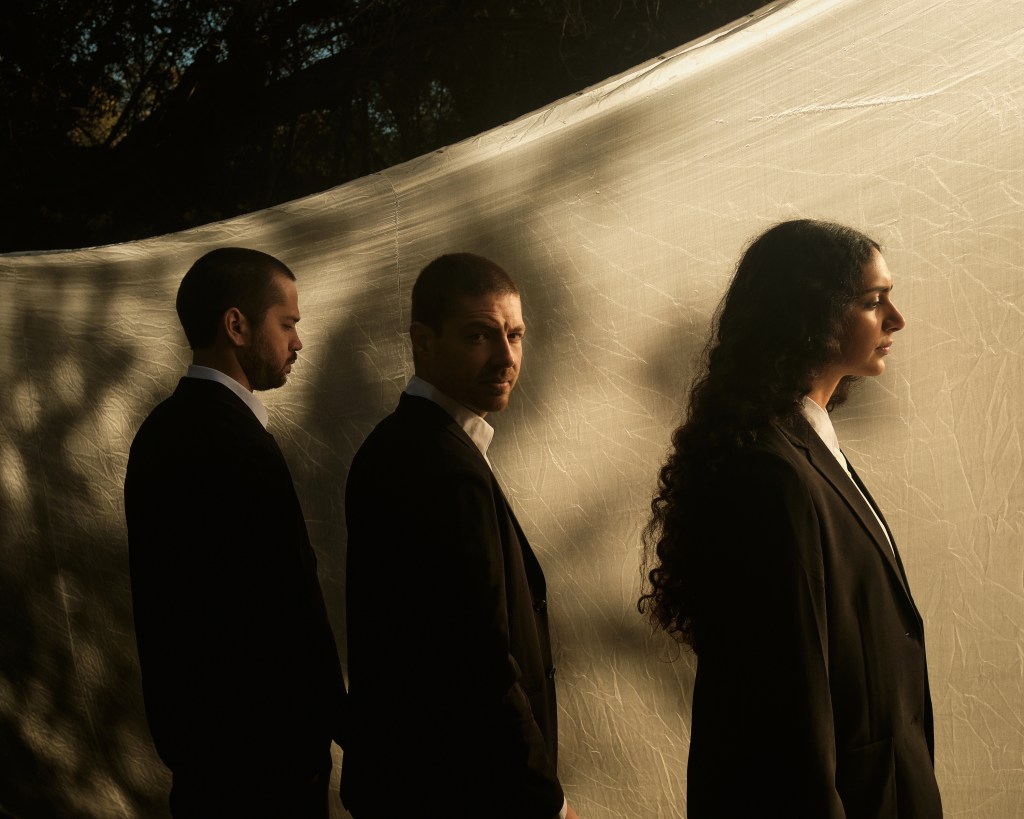
featured photo shot by Jacob Boll
“Not having another person to look to while making this record has been kind of freeing. We trust each other and ourselves to the point where we can do it all.”
Junaco reaches fuller heights in their latest album, In Motion, crafting a refreshing take on indie folk. death of a rabbit got to talking with the trio on In Motion and more!
DEATH OF A RABBIT: I heard from another interview that your band name was inspired by a street one of you grew up on. I was wondering, now that you are established with a few albums under your belt, are you able to derive meaning from your name?
JOEY: We’ve tried to make meaning out of it; then I read those interviews, and it’s so cheesy.
SHAHANA: Yeah, the honest answer is probably no. It’s just something we created that felt right at the time.
DOAR: How has your music evolved?
SHAHANA: I think, the more we do this, the more we figure out who we are (as artists) and the music feels more and more like us. With this new record, we didn’t work with a producer unlike the last two albums. Not having another person to look to while making this record has been kind of freeing. We trust each other and ourselves to the point where we can do it all. We can still push ourselves. We’re all really stoked and happy with how that turned out.
TEJAS: Between the three of us, we have pretty varied music interests and tastes. This record was made not by talking about how we wanted it to sound, but just by playing music together. It felt like all the sounds on the songs happened from that musical communication. That also allowed everybody’s ideas to live without being scrutinized. There wasn’t a lot of reworking or overthinking put into these songs at all. It was whatever everyone was feeling at that moment. It felt really improvised in that way, like the songs were definitely written before they were recorded, but there were no defined parts. So, when all three of us played together, it felt like a capture of that singular three to five minutes.
SHAHANA: And we got to work with an amazing engineer, Mario, at the studio that we recorded at. (He) really helped us not focus too much on the sounds, guided us in a way where we were able to just focus on recording.
DOAR: I did notice that you guys produced this entire album by yourselves. What was that like? How did you guys come to the decision to take it into your own reins?
SHAHANA: We got a little taste of (producing) when we recorded a few songs during COVID; we had no plan, just a vibe, and wanted to see what happened. It was just the three of us and that was nice. Especially after working with a producer for Where Does It Go. We had confidence after that.
JOEY: I think part of the project has always been trying to do something different.
TEJAS: (For) every record we’ve made, it’s been like, “What are we going to do differently this time?” And when we were talking about what we wanted to do, it was like, “Okay we want to work at this studio. We want to work with Mario Ramirez,” who is just an excellent engineer. Then it was like, “Do we feel like we need anything else?” “No, let’s just do this because it feels right.” I don’t think it was massively overthought, it was just different than last time.
We really prioritize the fidelity of these records. We all wanted to see what we could do in Sonic Ranch — where we recorded the albums and a really incredible studio — with access to all those toys and no rules, with Mario guiding it sonically just to see what would happen. It was so different because we made our last records in spare rooms in houses we’ve lived in. We’ve used whatever free space we had and whatever gear we had to make most of our recordings. So this time, it felt like going into a state-of-the-art studio with one of our favorite engineers in the world. Asking ourselves, “What would that sound like this time?” was how that decision got made, more than anything.
DOAR: How did you choose the first three singles on your record? Was it just based on vibes?
SHAHANA: Like every project we made, we were like, “Oh I think this is going to be a single,” while we were recording it. Then we asked people and they came back with different things. We try to decide amongst ourselves and then ask our friends because it’s hard to be objective in those situations.
JOEY: We decided based on what it was like when we put the song out, how that would make it feel. The first song kind of feels like summer.
SHAHANA: Yeah, (which song) felt like an easy intro to what this next record is going to sound like.
DOAR: I was also wondering what color you would ascribe to each of these songs.
SHAHANA: I would say green for “Find The Melody.” It feels like outside.
JOEY: I would have picked like aqua blue. I would give bright red for “Boston” and a yellow for the other one.
DOAR: Can we expect any music videos for this album?
SHAHANA: We’ve got one for sure for the record. Maybe another one, I don’t know.
TEJAS: For the last few songs we’ve done, we’ve at least been getting together and making really short visualizers. It has been fun to see what sort of imagery goes with (the songs) without pressure — also (without) the cost and investment of making full length music videos — while still being able to put some imagery out that can bring people into the world of what we’re doing.
DOAR: death of a rabbit likes to focus on lyricism and poetry — I was wondering, what’s a lyric that you’ve listened to lately that you really enjoyed, or what’s a lyric that you wish you’d written?
SHAHANA: “Because” by The Beatles!
TEJAS: “White Goose” by Anna Tivel.
JOEY: “One Trick Ponies” by Kurt Vile.
Check out Junaco’s work here!

Leave a comment