
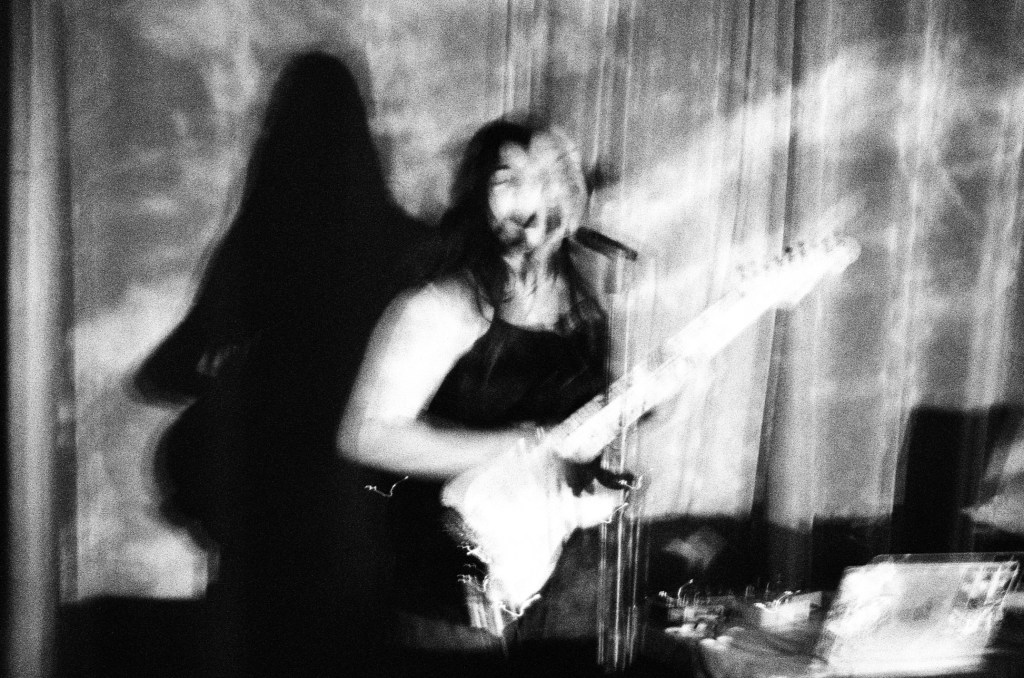
images provided by Planet Bones
“SAMSARA has felt thus far, like the thesis of Planet Bones a little bit. Across all my work, one common thing that I’ve always fixated on is death and exploring it. I think that was very much expanded on in SAMSARA in a physical, spiritual, and symbolic sense.”
Planet Bones likes to dissect the inner workings of reincarnation, picking through the bones of death and what it means to be alive. An International Student Broadcasting championship finalist, Planet Bones uses Diya’s knowledge of experimental music to develop Diya’s own depiction of the sounds of heaven and hell. Diya’s latest project, SAMSARA, continues this dissection and uses whatever it can find to show you the ways of reincarnation, such as digestion. death of a rabbit had the pleasure to sat down with Planet Bones to discuss SAMSARA and more.
DEATH OF A RABBIT: I wanted to jump into your experimental radio show first, because I feel like that goes hand in hand with your projects. Could you expand on the show and how, if at all, it influences Planet Bones?
PLANET BONES: That’s an interesting question! I would honestly say Planet Bones might have been more influential to Unearthly Machine than vice versa. The way the show started, it was a little bit broader in the sense that I would truly just play anything that piqued my interest. And I still do that to an extent. But there is kind of a chronological theme to it, where it starts off ambient, starts off beautiful, and it gets progressively more… I remember my boss at the station, he described my show as starting off in heaven and then ending in hell, because it would be very ethereal and ambient, and all of sudden would get into a harsh noise territory. I still very much live by that. I really like global–I hate saying ‘global music’–but, like, music from around the globe in experimental or other genres that you wouldn’t typically hear on American radios. I would play a lot of songs like that. I think now, in the past couple of years, maybe Unearthly Machine has been a little bit more connected theme wise. Instead of the thesis being anything that piques my interest–it still is that–but more along the lines of starting out in the ethereal realms, ending up in the hellish realms. The running theme is toeing the line between beautiful and disgusting, constantly just teetering on that little tight rope between those two realms.
When I first started the radio show, I was just about to release my previous album, Drones of the Desert. That’s also a very wide sonic palette, it has lots of different sounds on it, to a point where it’s a little bit hard to pin down where it’s going. You can kind of see that in the radio show, and then the past couple years of radio programming, you can see me shifting my artistic focus into toeing the line between ethereal and disgusting.
DOAR: I also wanted to talk about your latest album, SAMSARA. Would you say you view these songs as more of a collection of songs or more as a concept album?
PLANET BONES: It’s a concept album, and I think it’s also the way I tend to approach making albums. I have never released a single, and I don’t think I will for a while, unless… I think my version of a single would be a long composition that is meant to be standalone. But yeah, I would say SAMSARA is a concept album, because every song on there alludes to a specific section of what’s illustrated on the cover art, as well as through the lyricism, and it’s a running (lyrical) concept too. It’s also kind of arranged in a chronological way that fits that. I think I’m also kind of opposed to releasing a lot of standalone singles that aren’t pieces, if that makes sense, because to me, every album I make is a time capsule. Every single album has an array of characters, even SAMSARA has an array of perspectives and themes that I stick to very faithfully.
DOAR: I feel like what I picked up mainly in your album art and then your artist’s name, is bodily themes. In the album art, it looked kind of like intestines and a stomach, and then there’s also your artist name, Planet Bones. Is there a connection to all of that?
PLANET BONES: That’s a good question! I think a lot of my work tends to be very bodily, at least as of late, and I’m very fascinated with body horror. The main theses of this album are natural cycles of decay, natural cycles of reincarnation–birth, death, samsara. Digestion is like a mini samsara. This is extremely relevant to the body as well as the more metaphysical and more spiritual things. I think digestion is one of those mundane samsaras that we all go through, and so, on the cover art, my dear friend Jenna Vargas illustrated that. I had the idea of the samsara wheel, because that was the album title I had in my head for a very long time, and I knew that all the songs as I’d been writing them had that running theme.
There’s also the three characters, the snake, the deer and the vulture. The album jumps between the perspectives of each of these narrators and the essence that embodies and speaks through them. I know there’s usually three animals in the middle of that (samsara wheel) and I wanted my three animals to be those three, which I talk more about in the liner notes of the actual CD. To put it very simply, the vulture is a literal example of an appetite for death, right? A vulture feasts off of death. Its way of staying alive depends on death. That was really fascinating to me, the appetite for death. That was a huge motif for me; I saw the vulture as this disciple of death, faithful to death and decay, the things that we don’t want to look at.
The deer, specifically the deer with chronic wasting disease, was a really interesting image to me, because you’re juxtaposing rot and zombiehood with a symbol of purity, a symbol of beauty. You know, I watched Bambi and Princess Mononoke months after this album came out. I think they both articulated something really perfect about the deer, which helped me put into words why that animal is such a symbol of purity. In Bambi, it’s the prince of the forest and in Princess Mononoke, it’s the symbol of life and death. The deer is a symbol of pristine nature, and for it to be absolutely decimated by chronic wasting disease is such a crazy image to me. It’s also a very literal earthly symbol of limbo–being in between being alive and being dead.

Then, I also have the snake, which is a symbol for ouroboros, the Greek infinity, or circle of the snake eating itself. That was a really valuable symbol to me as well, because it symbolizes ambiguity between where things start and where things end. We depend on these cycles of rebirth, death, nature, decay, that kind of thing.
I think it also has to do with my own background. I was raised in an environment where one of the spiritual tenets was reincarnation. My current relationship with that is complicated, but I will say that I think growing up around all these ideas of reincarnation made me very curious about that sort of middle stage between being dead and being alive, being alive after being dead, that kind of thing, or so the idea of it. So, I think all of these creatures are relevant to that. Again, the writing kind of shifts perspective, and I wanted the cover art to really highlight that; so, I chose those three animals.
I told my wonderful friend Jenna about this, because I had a really specific idea for the cover art, and I’m more of an abstract doodler, mixed media and paint type of art person. Jenna has such an amazing talent for making these beautifully intricate drawings and I think they’re also influenced by Junji Ito’s art. Jenna had this brilliant idea to put the three animals in the stomach of an animal.
DOAR: I also wanted to talk about the albums you’ve put out, they’re very different from one another. They have different sonic palettes and it feels cool that you have these different eras almost!
PLANET BONES: It has a lot to do with age! I was very, very young when I released Parasitism, like 14 or 15 when I wrote that. It was very much me listening to a lot of R.E.M., Alex G, etc. when I was in early high school. This was actually the second thing I recorded, but it was the first thing I recorded on a computer, which was the most legitimate thing I had. I recorded it on Garageband, and it was very much a psychedelic folk type of album. I look back on it and can definitely see the teenhood or childhood in that album.
Then Drones of the Desert was also in high school, composed and recorded mostly during quarantine. It’s so funny because Parasitism came out literally a week or two before we went into quarantine, and everyone was telling me I predicted quarantine, because there was the hand washing element in the album cover. Then the next album, I started working on immediately because that was kind of my way of doing things; I couldn’t exist on this Earth without constantly making something. I still am that way. I released it in 2023, during my freshman year of college. I was really young, and it was very much a teenage album that way. It’s a very California album.There’s a lot of references to wildfires and climate change and that kind of thing. I think that album is really just a portrait of being very young in a dystopian California and figuring out the literal geographical climate, but also the social and political climate at the same time. My influences were a lot more varied as well. I was listening to a lot of synthy prog-y stuff—a lot of people are like, “Your songs are so oddly shaped on that album; they’re all prog-y!” I agree to an extent, many of the songs are five to seven minutes long and have time signature changes.
SAMSARA has been in the making since after Drones of the Desert, and it was very much a color palette and age thing. The biggest thing that was on my mind was body horror and the internal aspects of my songwriting, because, again, Drones of the Desert is very external, and is SAMSARA very internal, right? Because Parasitism and Drones of the Desert seem more rooted in physical reality versus SAMSARA, where it’s both hyper-physical with the bodily aspect and metaphysical with all the religious references, SAMSARA has felt thus far, like the thesis of Planet Bones a little bit. Across all my work, one common thing that I’ve always fixated on is death and exploring it. I think that was very much expanded on in SAMSARA in a physical, spiritual, and symbolic sense.
DOAR: Being a visual and video artist, how do you incorporate other types of art into your music? I know you recently released a music video for “Ouroboros” and saw that you did a lyric zine for Drones of the Desert.
PLANET BONES: Yes! So, the zine was me putting my lyrics in a journal format, and then literally scanning my journal. I’m working on a zine for SAMSARA right now, and I’m very excited about that. I really like the handheld and physical aspect of having a book of lyrics. Since I am a writer as well, it’s just something I value a lot, you know, lyricism in general and also just print. I also like putting little illustrations or mixed media art in the zines as well.
For other forms of my art, I’m a huge fan of weird experimental films. I am a complete amateur; I have no training. I use whatever’s on my computer, whatever I can afford at the time, to make whatever, shot on a little digital camera or whatever I have on me. But for “Ouroboros,” my beautiful friend Noah let me borrow their nice filmmaking camera. That’s why it looks a lot nicer in terms of image quality than my previous music videos. My other friend Leah let me borrow her projector, so I have that kind of scaly projected texture. And my friend Isabelle graciously did the choreography and the dance performance for that. That was definitely a little bit more of a collaborative project than I’m generally used to, which is really cool.
DOAR: death of a rabbit likes to focus on lyricism and poetry — I was wondering, what’s a song with lyrics that you’ve listened to lately that you really enjoyed, or what’s a lyric that you wish you’d written?
PLANET BONES: Joanna Newsom’s “Sprout and the Bean”.
Check out Planet Bones’ work here!

Leave a comment