
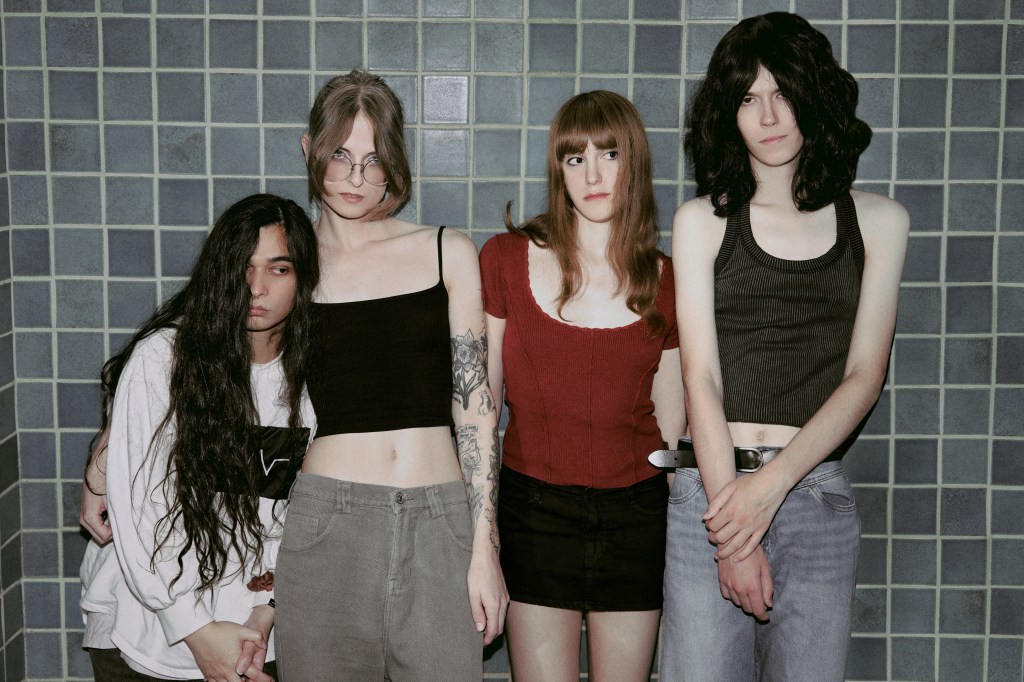
Featured Photo by Kenna Sharp
“tearyeyes is from wherever your hometown is.”
tearyeyes melds into the rivers that permeate America’s being. Hailing from Los Angeles, the band of four made me feel like they were connected to the modern Midwestern indie scene somehow or born from somewhere “over yonder.” tearyeyes fittingly calls their music “transamerican guitar music.” Regardless of where they are stationed, it’s something anyone can bite into, sustenance for the soul.
death of a rabbit had the pleasure of interviewing K Tessa and Roxie Drummond of tearyeyes on their latest release, idk. idk is out now, August 31st, on streaming platforms.
DEATH OF A RABBIT: When was the last time you cried?
K TESSA: I cried in my car super late the night after practice. Not because of practice – way, way later in the night, I was so tired and shit. I saw “Camp Miasma” and it brought a lot of stuff up for me afterwards. Why did you cry [Roxie]?
ROXIE DRUMMOND: I think it was my career and life stuff and anxiety. I also kind of messed up my shot schedule this week.
DOAR: Is hope real?
K TESSA: Of course hope is real. I don’t want to speak for all of us, but I feel like perhaps transsexuality is impossible without hope.
DOAR: Could you describe your genre “transamerican guitar music”? I don’t want to put you in a box of being trans because I don’t want it to seem like “oh you’re a good trans artist” instead of just a good artist.
K TESSA: I mean you have to make your own genre. You have to describe yourself somehow. I also don’t mind you bringing it [transness] up. I appreciate you not wanting to put us into a box, but the world will categorize us as such regardless. And, you know, we did construct this group of people very intentionally. So I think it’s kind of unavoidable.
I think the thing is that it’s not– like it [transamerican guitar music] is a pun. Yeva doesn’t like it very much because it’s a pun, but I do in the sense that it applies to every aspect of what I think, at least me personally, I want to do with tearyeyes. I think a lot about bringing a queer politics to every stage of being in a band, you know, queering the music, the genre of music we play, queering this interaction between band and press, the interactions with fans. We have to participate materially in this sort of ecosystem, but doing it in a way that feels authentic and different.
ROXIE: I almost want to ask a question within a question. Because we have the band photo where Tessa is miming an E shot, and it’s like… what does that mean for the band? Why is that what we’re kind of leading with?
I think there’s a part of me where it’s like locally, the trans community in LA is who I’m doing it for. They have been our biggest supporters when we were starting out, and we’re still starting out. So many dolls come to our shows. That’s the character of our audience as well as us.
K TESSA: Not exclusively, but it is crazy to play a show and have somebody say that they came from Portland and happened to be in town or someone drove an hour or two to be here. I think it’s funny: one of my favorite interactions was with Leah of Club Cafe, Judy, and Agriculture, talking to her at a show and she was like, “Oh well, you know, the most trans people you can have in a band is two,” and I was like, “I got four babe. I don’t know, skill issue?” and we laughed about that. But it is an intentional, unique thing.
DOAR: Absolutely. I also wanted to talk about how y’all are based in Los Angeles. What is the Los Angeles sound to you? Because for me, when I hear your music, I hear the voices in Indiana a little bit. So I was wondering what that sound is to you because the only other artist that has a similar vein that I can think of is Phoebe Bridgers, who I didn’t realize was from California because it didn’t give that vibe to me. I guess I do stereotype California as surf rock and punk, but your sound seems more desolate and more like in the woods.
K TESSA: That’s a great question. I think what is resonating with you is the transamerican part, that’s what that is. Maybe this is a hot take, but I don’t really subscribe to places having “sounds” inherently. I think a moment in time in a place can have a sound.
I think it’s really interesting that all four of us are actually from LA. Like we are LA locals making this kind of music, and part of that, as you know, internet kids and everything else, you pull from everywhere. We are an LA band because that’s where we are. I don’t think I’m trying to say something about Los Angeles as much as I’m ever trying to say something about America.
DOAR: That’s a good way to put it!
K TESSA: tearyeyes is from wherever your hometown is.
DOAR: “canary” is your latest single you’ve put out. I think it’s great as the lead single itself because out of the EP, it has the strongest voice in my opinion. I think maybe there were some biases there as I read about what it meant, but it seems intentional and very well placed.
K TESSA: Thank you. If you’d asked me six months ago which song was going to be the lead single, I would have told you “bloodlust.” I think it [“canary”] feels like the most correct one because it feels like the clearest indication of where we’re headed in a sense. That’s a song that more than the others, we really wrote more as a band.
At the very first tearyeyes rehearsal in December of 2024, we jammed the “canary” chords. Elisa wasn’t even there; she wouldn’t join the band for another six months. We messed around with the main chords for a while, and as soon as we were done, Roxie was like, “Oh well, that’s going to be a song.” And I started this project solo, I never played “canary” solo. The first show I played it at was the duo show with Yeva in April 2025. So it very much feels like ours, whereas the other ones were more the songs that I wrote that reminded me like, “Oh, I do need a band. I want a band.” Roxie, how do you feel about “canary”? I feel like it definitely has your best fill on the record.
ROXIE: That might be my best drum song. I changed that fill when we met up to record, at the last minute.
K TESSA: You had never hit it like that before the recording. We were literally in the studio and Cleo Henman, who we recorded with and is awesome, the take before we had done the whole thing to a click, and then on that take, she was like, “Hey, coming out of the bridge, I’m gonna get rid of the click. I think you guys should play it at whatever tempo you want to play it at.” And we were like, “Okay,” and it was just perfect. It speeds up a little bit, but it feels correct, you know? And then, yeah, you [Roxie] just hit the sickest shit of your life.
ROXIE: That might have been a day of recording invention. It felt like that recording weekend brought some magic out in a lot of ways that wasn’t there before.
DOAR: I was looking at your lyrics on Bandcamp and wanted to know about your aesthetics. Why the lowercase and why is it so journalistic [in a writing in your journal way]?
K TESSA: Everything’s intentional. We don’t do anything in this band without intent. Why do I do it? It feels like the right thing to do. I think about it in terms of: the song is art. It’s a medium of artistic expression – but a lyric page is a separate piece of art [for example]. It’s working within an established format and rebelling against that format or doing interesting things with it. Not using that space to do something else or say something is kind of a waste. I think the one of the best at this, probably the two, are Bon Iver and Dijon. I think if you’ve never taken a look at the lyric sheets that come with the vinyl of 22, A Million by Bon Iver, I really recommend it.
DOAR: The last song on your EP, “unfurling,” is about eight minutes long. How does the length of this song highlight it? It also comes in like three acts or stanzas and I like the repetition at the end. It’s not necessarily a mantra but it’s kind of that style.
K TESSA: Do you think it earns it?
DOAR: The length itself?
K TESSA: Yes.
DOAR: I think it does, I guess for me, it doesn’t feel like filler.
K TESSA: I never set out to write a long or short song. I think you have to be really careful not to let a song get too long. On previous versions of “unfurling,” there certainly was more filler, more repetition at the end, things like that. It’s long, but it’s only long because it’s slow. It takes time. It’s not long because it’s jam packed with a ton of different ideas. It has two verses. That’s probably the thing on the record that I’m proudest of, like how it came together. It’s also the only track we didn’t record with a click at all, because we couldn’t have with that intro. So as a result, I think to me, that’s what tells me that we earned it. That was also the first take.
DOAR: Woah!
K TESSA: We did another one for safety but we knew.
DOAR: That’s a flex.
K TESSA: It was a moment in time.
DOAR: death of a rabbit likes to focus on lyricism and poetry — I was wondering, what’s a lyric that you’ve listened to lately that you really enjoyed, or what’s a lyric that you wish you’d written?
ROXIE:
i don’t want to feel this way but i’m jealous every time you say that
“this whole thing has changed my life” but I never had that kind of moment in my life
Kara’s Walk Home, “bad feelings ;^(“
K TESSA:
I like how you look when you get good news
Dijon, “Big Mike’s”
Listen to idk below!

Leave a Reply