
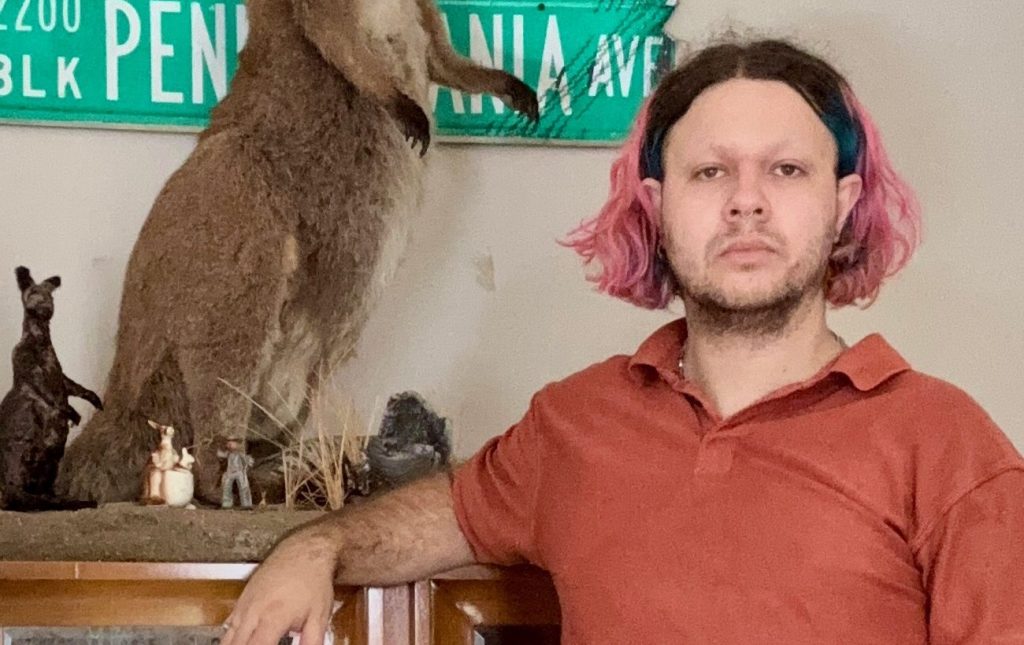
Beam Zillion, the moniker used by the singular, pink haired poet Twillian Ün Pomp, creates sounds like that of a balmy reverie. The anachronistic sentiments diffused throughout their newest record Upstairs, Downstairs appear to be glinted by the remnants of something cosmic, astral. Hailing from the deserts of New
Mexico, Twillian moved to DC in 2021 and has since become immersed in the city’s DIY music scene.
DEATH OF A RABBIT: I know Nipper by Thinking Fellers Union Local 282 inspired at least one lyric on your latest record Upstairs, Downstairs [Crimson pulsating mush in the song Fathering]. What are some other musicians, poets or movies that inspire the Beam Zillion sound?
BEAM ZILLION: CAN has this twenty-minute song called “Yoo Doo Right” and I would play that thing back to back to back every night for a while. Malcolm Mooney sang on that song and was doing some wild stuff that really excited me and pushed me to experiment with my voice too. The liner notes on the album claim, rather fallaciously, that a short time after their album Monster Movie was released Mooney suffered a mental breakdown and began frantically shouting “upstairs, downstairs” over and over.
Things like that, like Andre Breton’s dreams, Arthur Russell in the studio with Vin Diesel in 1986, Rare Joe Meek Recordings of the 60s, Robert Mitchum as Harry Powell, Atari’s burial of the E.T. game cartridge in 1983 outside my hometown, talking in funny voices, long woodworking videos, Mister D’s Machine, flipping off every cop, Confederacy of Dunces audiobook, American Works for Balinese Gamelan, being poor, Jug Bay Wetlands Sanctuary, NTS Radio, “Arizona Colt” opening theme, Death of a Salesman on Broadway, The Doppler Effect, The “unclassifiable” Ghédalia Tazartès, mysterious strangers in spaghetti westerns, Screamin’ Jay Hawkins’ acting career, dirt-scented perfume, Scott Walker’s vibrato, mezcal made with gin botanicals, The Koker trilogy, sonic booms, Tommy Jay’s Tall Tales of Trauma, Baudelaire’s Intimate Journals, etc.
DOAR: All of those actually make perfect sense. Talking in funny voices and flipping off every cop forever. The last song, or epic, since it’s 16 minutes and 37 seconds long, Man On Demand feels very nostalgic to me. Is there a story behind why you chose to put in those specific voicemails and to make it the closer on this record? I also think it’s very awesome that your credits read “clapping, walking, running, door slams”.
BZ: I think Man on Demand draws the deepest emotions out of its audience (myself included) than any of the other songs. It takes you for a ride through a handful of sprawling scenes, most of which are instrumental and, speaking from experience, that’s a rather potent recipe for reflecting, wondering, dreaming, all those dirty words. Sentimentalitis as my best friend Alan Bishop calls it. But I do love to visit those lands on the last track of an album. On a lot of great, singular records the last song sums it all up, ya know? Exuma’s “Exuma, The Obeah Man” comes to mind, or “Spirit They’re Gone, Spirit They’ve Vanished”. That one ends with a long tune as well.
Jake totally transformed this song. I had sent him a single-take approximation of the final piece then one day without warning he just texted me this new Man on Demand that sounded as if my version had just been hauled through a car wash. There was beauty so suddenly visible in all the empty space and the voicemails were an all timer decision he had made to accomplish that during its moment in the song. He nor I had a clue what, or who, a man on demand actually was. I just liked the way it felt to sing that line. He figured that with all of these voicemails from people trying to reach him, he was, at least in part and in some way, a, or possibly even the, man on demand. Jake’s family can be heard singing happy birthday to him and chatting in a group. Before we put the album out, one of his relatives, a prominent voice in that voicemail passed away, and I, despite never having met the man, cry most times I listen to this song because of that man.
DOAR: What sparked the move from NM/Arizona to the east coast? Have there been any notable differences in the music scene you grew up in compared to the one in DC?
BZ: I was enjoying life in Tucson a fair bit at the time. I was a joint custody child between rural AZ and rural NM when I was growing up so when I moved there it felt like the big apple. Being freshly twenty-one also helped with that. I still really love that city, the landscape, and so many people and pets there; R.I.P. Opie Willis. I was living with my close crew of homies and lovers in 2020 after the pandemic was declared. Some of the best times of my life. I started sourcing the material for my album The Estranged Orchestra during that time. We lived in this beautiful, dusty old home directly across from the mall of the University of Arizona, where my best friend Logan spraypainted “#FREEPALESTINE” on the big red A in the grass at the entrance off Campbell, which was scrubbed from its monument within two or three days. After almost a year of this, my friend Emily earned her masters in economics and took on a remote job in Washington, DC. She and two of our friends were planning a move to the capital and then to Emily I sprung the big question: “I’m not doing shit with my life, can I tag along?” No one deliberated for even a moment before bringing me aboard. The great times continued to Maryland in June of 2021. I had never experienced 4 seasons before this move took place and now I am in love.
Tucson can have any music scene you want. You can really find any sound out there. I quickly discovered DC isn’t dissimilar though and they’re both considered small cities. But back in the fine, dry land of Sierra Vista, Arizona, myself and several friends I had during boyhood discovered John Fahey, a guitarist who is credited with creating, intentionally or not, the instrumental guitar genre called American Primitive. This type of guitar playing I find, at least in the way Fahey first played, is what would come about if a crossroad’s hex was cast on Charley Patton so that all of his inner monologues were replaced by the most distinguished concertos from Amadeus Mozart’s repertoire on a loop in his head until Purgatorio freed him to his earthly paradise by way of the River Lethe, the river of forgetfulness, so that he’ll not remember that the end must come only by way of dying. Most people I knew, in my potentially faulty human memory anyway, knew of Fahey’s music.
John Fahey played this tune called When the Springtime Comes Again. A remarkable piece of music that depicts the world, or the soul, or something, coming to life after a deep, dark holler of a winter had swallowed it whole. I’d wondered for years about the realm that’s created by an oncoming spring in Maryland where he was from. Having lived through those springs many times now I can say it’s a striking, breathtaking scene every time. John Fahey isn’t really mentioned around town though, nor his allusion to winter’s killer. Be this due either to ignorance or a moment’s lazy coming and lazy going, I’m not so sure. I’m just one, tiny sample size without access to every conversation around me. If we imagine his lack of mention to be true for the sake of my answer to your question though, I’d say that a musical world in the hands of John Fahey’s music feels a less desperate, colorless world than its counterpart.
DOAR: How did the writing/recording/mixing process work since Jake Freeman from Jerry Russo, who you collaborated with on this album, lives in a different state?
BZ: Jake and I played music together as teens in southern Arizona. I even recorded his first EP on an old, glitchy Tascam DP-24. I remember having to wrap that thing up in hand-me-down sarapes every day when I brought it over to his place out in the sticks during monsoon season. We were tight and sort of dipped our toes into the live music world together. We made our own solo records over the years and have always admired each other’s work. We’re buds after all. Figuring out how to make an album together took about 40 seconds on the phone. We sent each other some acoustic songs we had written and the other person added everything else. That was the general workflow for a time. Man on Demand was the only, even remotely, new song of mine that made it on the album. Every other song was written back in Tucson between 2017 and 2020. I was really clinging on for dear life when I wrote Arrowhead, Fathering and Burn Ow!. Once we felt like all of the production was done, we decided that I would drive up to Chicago where he lives to re-record the guitar parts of mine in a more optimal setting. That took maybe 3 days of light work. That’s also where we recorded all the sounds at the end of Man on Demand: clapping, walking, running, door slams. Right there in a sort of liminal room in his creaky house. We wrapped on my birthday after I recorded the guitar for that song in its entirety on the first take. An unreal feeling when I plucked that final string for sure. Most of Jake’s songs didn’t land on the album, only Chip. But you can listen to a song we passed back and forth many times on his new album Haymaker. I provided percussion for the song On The Roof. That one was almost on the album.
Arrowhead ended up with over one hundred individual tracks so I mixed that, since it was my fault for adding so much shit to it over the years, along with Fathering and Chip. Jake did the others and I did a rough sort of mastering of the whole thing at the end.
My best friend Katie Burkholder from Tucson takes wonderful photos and she took a whole bunch for us to use for this project. Being unable to choose the album cover was a silly problem to have but definitely a problem nonetheless. I ended up zooming way in on one of her photos and something clicked into place for me. The cover ended up being less than a quarter of the original frame with the addition of some light cosmetic editing from me.
DOAR: Wrapping the album on your birthday is kismet. What’s the best show you’ve been to recently?
BZ: I don’t attend many shows as a patron these days because I’ve sadly developed somewhat of an allergy to them due to my working as a live audio engineer in the city. Not always, but usually I have to really, really, like the artist in order to get out and see them.
I was operating the board for this thrash metal band called Antagonizer the other night at Songbyrd and they were truly wild. The vocalist was all over the place and kept every part of their body, including vocal cords, in constant motion the entire forty-something minutes. I had their guitars and bass muted on the board for their entire set because their amps were so incredibly loud that I swear they shook a pipe loose in the venue.
DOAR: You just released Upstairs, Downstairs in January, but do you have anything new in the works? Any shows coming up? Things you’re working on for other people?
BZ: There’s usually always something stirring away. Earlier this year I produced the debut album for my good homies in the band Bloiters and most of my year has been focused on mixing it. This is my first time mixing someone else’s album but it’s going well. Their first song Inkless came out recently actually, that’s off the album. They’re already talking about possibly recording an EP so I’ll have my work cut out for me there but it’s my job as an honorary Bloiter and I’m joyfully along for the ride.
Before I got mixed up in all that I was trying to wrap up two albums of my own. One is in the mixing phase, it’s called Shshes. My recent live sets have a number of songs from that album on the setlist; no guitars. The other album isn’t ready enough for me to start spoutin’ off about it but it’s a quiet kind of style; guitars.
Another project I want to focus on when this all wraps is a book I’m making that’s just 1001 new baby names. Basically what it sounds like: a book of baby names that have never been used before. I’ve come up with all the names but I want to draw 1001 baby faces to accompany them. It’s taking just as long as one might imagine but I’m always in a cycle of doing things the hard, or even hardest, way when they don’t need to be done at all, ever, by anyone. I’ll rough it through an impossible project because the feeling of finishing it is damn near the greatest feeling I know. Especially in an age where I can’t navigate two webpages consecutively without being introduced to at least 5 AI assistants named Winston, Alfred, or one I encountered today, while looking at a product to help with cat allergies, named Benjamin. A book that will, in the end, have taken me likely over five years to complete can just be generated in a few moments. It’s not a novel annoyance but it makes me want to explore the fringes of what I think I’m capable of; physically through skill, practice, or labor and emotionally through patience and raw human ingenuity.
I’m playing at Rhizome for Red Brick Weekend on November 14. A matinee at 1pm, may have a few layers of sunglasses on for that one. Rhizome is great though and it’s been a dream of mine to play there. It’s an important fixture for the people and music of these parts and I’m excited to become a part of its story.
Check out Beam Zillion’s discography below!

Leave a comment