
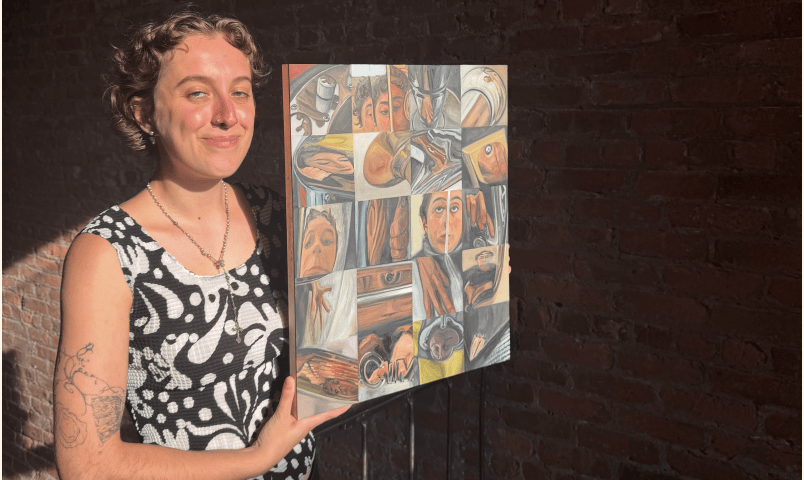
Photos provided by Gabby Paisner
Interviewed by Aidan Ashland
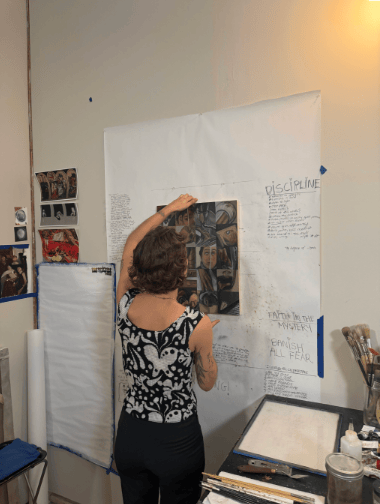
I meet Gabby at her studio in Williamsburg, my shirt stuck
to my back with sweat thanks to the 100 degree subway
station. She meets me outside, the tattoos that cover her
arms and legs bared to the August sun. As we summit the
stairs of the pre-war, brick walled building, we’re met by
the sounds and smells of the other artists in the building. A
sewing machine clatters, punk music emanates from an
open door where an artist stares at their drawings. It smells
like paint thinner, old wood, and cigarettes.
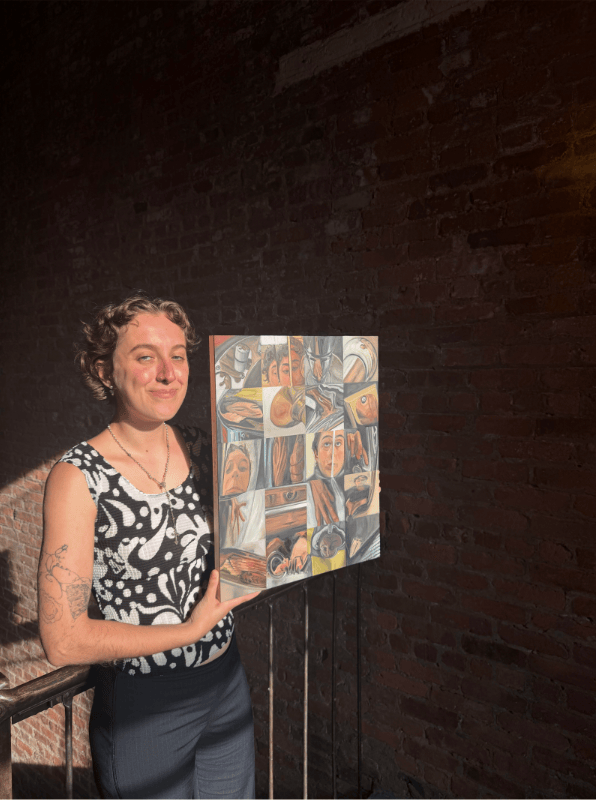
Mounted on the artist’s wall is her latest painting, “TLDR:
Disco Nudie Quilt for Gma” a 16″ by 20″ amalgam of 4
inch squares each depicting snapshots of the artist caught
in what she refers to as “interstitial” moments of life:
GABBY PAISNER: “I started seeing these reflections of myself in my apartment when I was naked at these interstitial moments.
I took images of myself, my body, which were distorted in
these hilarious and evocative ways. A reflection where my
head is tiny, my hips are huge, one eye is lopsided – and like,
that looks like how I actually feel in a way that I’m not able to communicate to other people. So I started to collect these images, and paint them. I was thinking of making a work composed of smaller works, to be able to sell off the individual paintings to even further increase the accessibility for people – and how beautiful it would be for multiple people to have parts of this whole. It’s a painting. but it also gains this sculptural dimension when the pieces are subdivided. But the reality of buying twenty individual panels was too expensive, so I had to do it on one panel…”
DEATH OF A RABBIT: “You could always cut it apart.”
GP: “Laughs You’re so right! Did you bring your chainsaw?”
DOAR: “Yep, I bring it whenever I come to Williamsburg.”
Paisner began ideating how these warped self-portraits might come together as one cumulative tapestry. Or perhaps, quilt.
GP: “It [the painting] started as being very motivated by my grieving process about the death of my grandma. I wrote a letter to her at one point, trying to determine how I related to the painting, and how I wanted others to relate to it. I had moved to New York six months prior and I was thinking about how I wanted to work smaller, how space is such a commodity here and how to make works that are considerate of that. I was thinking a lot about accessibility. In college I had been pushed to work really huge, but big paintings aren’t accessible for me to make, for people to afford, or for people’s apartments. I was also thinking about using painting like a different medium. I love when people make something in one work that looks like it’s made in another. Then I realized that the painting is a quilt, that I was quilting. laughs“
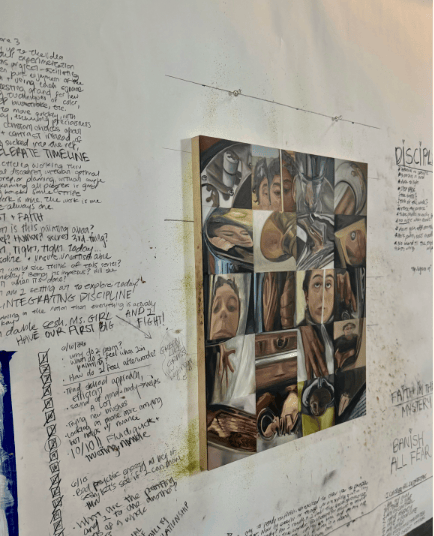
DOAR: “You referenced the humor of these images, that they felt like more of a true representation of your grief than you were able to convey in reality. Can you speak more to your experience of grief and humor together, experientially and how that relates to the painting?”
GP: “I don’t know if I’ve thought much about the correlation, it just is within this thing. I know it’s so played out, but I use humor as a coping mechanism. I just love to laugh, I seek it out in everything. My grandma loved to laugh. That’s something we have in common, something that I got from her. It [the painting] does make me think about her. She was orphaned when she was young, by the time she was my age she was a single mom to three kids. But you never got that when you were talking to her, it wasn’t what she chose to define her. She lived in a way that
was so full of light and encouraging of others to embrace that. She lived her life with such levity. One of her and my grandpa’s sayings was ‘lighten up!’ When she was dying, my cousin and I went back to Portland. We were talking about how we thought she was gonna die on Christmas, because she loved Christmas. She lived for it. The situation was so sad but there really would’ve been something so poetic about her going then. It was like, trying to give her some kind of agency … like she still has the will power to decide to die on Christmas. laughs“
Dichotomy and harmony loom large in Paisner’s life and practice. Her ability to execute hyper-realistic oil paintings – no small feat – was honed in a very technical fine arts program which gave her the tools and education to paint in this challenging style, but also left her disconnected from the emotions and felt experiences necessary to inform it.
GP: “There’s a lot of neurosis and self-doubt that prevents me from doing the work and being satisfied with it. In the past I’ve had to push through those feelings in order to actually do the thing. My senior year of college I worked on this giant triptych that actively sucked the life out of me laughs I started presenting with chronic illnesses because I was pushing myself so hard on it. I was doing group critiques with arbitrary deadlines, which is helpful up to a point… But then I realized they would rather have me dead and make something good than go at a healthy pace. With what was still a really new thing for me! I had only been painting for less than three years, and I’d already lost the intimacy with my own work. It felt like that painting was ripped from me prematurely. I didn’t have the time I needed to pull off a project like that. I’d been encouraged to bite off more than I could chew by my professors who were telling me “that’s how you become an artist, how you show you’re motivated and differentiate yourself.”
“It was one of the most miserable periods of my life, because I was so married to this project that I ended up hating. So
being able to work on this in my own time has been incredibly healing and really beneficial to the work itself.”
Paisner’s education and ability afford her a remarkable ability to portray beauty in her paintings. But
painting something pretty just isn’t enough.
GP: “In the past I was really trying to find my footing when it came to ideating a subject that had any substance. When I started painting, I just needed to figure out how to paint. It was very representational, in the style of baroque portraiture. I really wanted to learn how to paint faces and fabric and make things
that looked beautiful. Then I did a semester in Florence Italy where I trained with a professor who was really amazing. They pushed me to not be so conventional in the way that I was approaching what I was doing, and cleave less closely to the reference material and have more agency. So then I did these found still lives – which aren’t really like anything I do anymore, I still like to work naturalistically – but that was definitely a flash point for me. This feels like the first painting that I fully exerted control over, that doesn’t feel like a direct replication of something else I’ve seen before. I was just doing representational stuff because I thought it looked pretty Once I figured out how to paint I just got… bored of exclusively painting things that looked pretty.”
This application of her technique and imagination in making something distorted, evocative, even ugly marks an important turning point in Paisner’s development as an artist. Along with her interest in portraying something other than “pretty” there came space for the “less pretty” emotions she once pushed aside.
DOAR: “I’m curious about your personal history of disconnection as opposed to your feeling more
emotionally connected with this painting.”
GP: “There’s this play between diametric oppositions. It sounds dramatic, but: love and hate, life and death, beauty and ugliness. That to me is where the humanity lies, and the pleasure for the viewer. And the humor – these disjunctions. When I’m working there’s always a lot of perfectionism, fear of failure. Which is something I’ve always loved about painting since the beginning – I haven’t been forced to confront that in any other domain. In the past as a former gifted and talented kid, if there was something I started and wasn’t immediately good at, I’d just quit. Painting is something that I have struggled with from jump – she is a fickle mistress! There’s so much that goes into making art that relies on serendipity and mysticism that is out of your control. So much of my process has just been me getting in my own way,
and then getting myself out of my own way so I can enjoy it…”
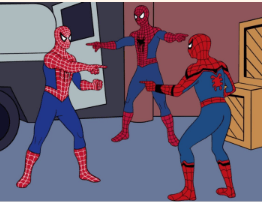
DOAR: “Which is interesting because the subject matter is you. It’s like the Spiderman meme. Like, you have to get you out of your way so that you can successfully paint portraits of… you.”
GP: “Yeah, totally. Laughs It was really fun to paint myself actually.”
DOAR: “Have you done that before?”
GP: “Yes, once. It was the first large painting that I ever made. It was this life sized melodramatic portrait of me holding a knife to my own throat, but like there are two of me. People are always like “oh that painting where you’re killing yourself.” You don’t understand. I’m not killing myself… It’s more complicated than that. I’m holding the knife, but I’m not doing it. And I’m looking at myself with an expression of concern.”
DOAR: “Where is that painting?”
GP: “I actually took it off the stretcher and rolled it up…. laughs I didn’t want to look at it anymore. I was unmedicated at the time, you know how that goes.”
Another of Paisner’s rejections of the modern conventions for artists is her general absence from social media. One might presuppose this to be indicative of shyness or insecurity, and by extension this piece to be a kind of exposure therapy or exercise in self-understanding, but the artist is quick to correct that idea.
GP: “I don’t have any issue with representations of my
physical form. I found it really fun to paint myself in these distorted ways, it was interesting – very silly! Learning the shapes of my face, my body and fingers. Like, you see yourself a million times. But you don’t really understand: oh this is the color of my lips, where my eyebrows start thinning, where my hair starts to curl.”
DOAR: “Do you feel like you understand yourself better
as a result?”
GP: “That wasn’t really the point. It is a self portrait, but it’s more about me exploring these themes visually. I wanted to experiment with working on panel, and with modularity.”
DOAR: “At what point in your material gathering did
you understand it was going to be a series?”
GP: “Immediately. Seeing myself in the shower handle..
But I was never able to take that photo. You’ll notice there
are no phones. I didn’t want to paint a phone – I didn’t want it to be about technology, or self image. So I had to get a lot of help for some of these in order to not get the phone.”
DOAR: “Yet the phone is almost implicit. Like it’s exerting this presence, though it’s not seen. I considered going down this track with you of social media and image. You’re not really online, or on social media. So it’s an easy assumption to make when wondering what the thing is about.”
GP: “Yeah and the squares are like, retro instagram. One thing about me is that I don’t GAF. Since high school I haven’t shaved my legs, which is ironic since there’s that one photo from laser hair removal… Of course I have my own demonstrations of vanity, but I don’t have any issue putting something like this out in the world where I look kinda fucked up. I find it really funny. Performativity is another through line in my work – I staged all of these photos. I chose the crop, the location.”
DOAR: “Which also makes me think of the thing: learning how to portray something beautifully, so that you can portray it honestly. I don’t think you would’ve come to this were you in a place of needing to portray yourself in a way that served your vanity.”
GP: “Yeah, and that’s something I love about myself. I take my art seriously but, I don’t take myself too seriously.”
On whether this style, emotional access, or new state of mind is the start of something new, the artist leans
into the not knowing.
GP: “The great thing about making art is: it’s an exploration. It’s your attempt to explore a question without answering it. It’s not prescribed. If you know what you’re doing and make exactly what you expect to make, there’s probably something lacking. I’m trying to operate from a place of not knowing. I want to
experiment with overlap, and transparency. I don’t feel the need to paint myself again… Or maybe I will. I have this idea kicking around about my Hinge profile being shadow banned, called ‘Hinge wants me to
kill myself.’”
DOAR: “What an incredible way to secure a cease and desist.”
GP: “Laughs That would be so funny!”
Locations of each image starting from the top left corner:
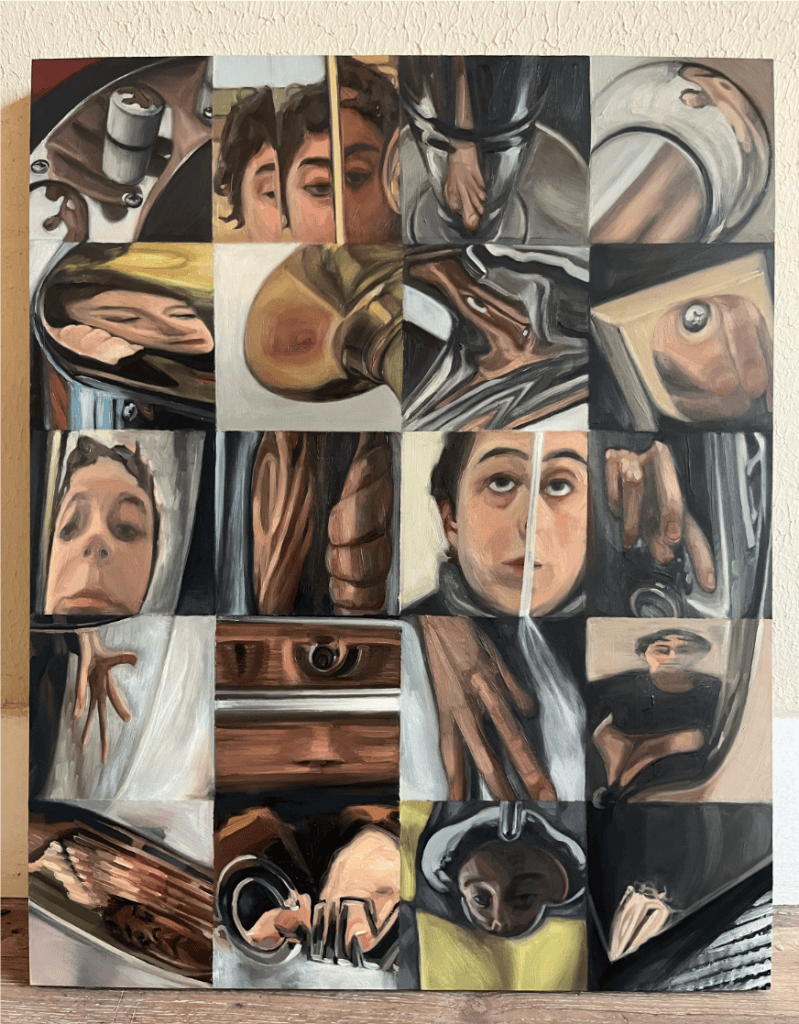
- bass guitar
- mirrors at the restaurant which laid me off with 16 hrs notice
- friend’s stripper pole
- towel rack
- bar tap at the other restaurant that I quit because I was being sexually harassed
- door knob in my room
- mirrored sculpture of a figure seated inprayer
- metal behind doorknob
- knife
- carafe
- mirror
- soap dispenser
- coffee machine
- ticket holder
- restaurant implement
- hand dryer
- faucet
- coffee machine
- tuning peg
- mirror in elevator on the way to laser hair removal

Leave a Reply